Working papers
-
A Division of Laborers: Identity and Efficiency in India
Conditionally accepted, Econometrica
Press: Ideas for India, VoxDev Talk
Abstract
Workers’ social identity affects their occupation, and therefore the structure and prosperity of the aggregate economy. We estimate a general equilibrium Roy model of this phenomenon in the Indian caste system, where work and identity are particularly intertwined. New data on occupation, wages, and caste’s traditional occupations and social status show that workers are over-represented in their traditional occupations and under-represented in socially higher or lower occupations. We consider counterfactuals removing castes’ hierarchical and occupational links. Despite more efficient human capital allocation, aggregate output gains are small — in some counterfactuals negative — due to weaker caste networks and reduced learning across generations.
-
Political Determinants of the News Market: Novel Data and Quasi-Experimental Evidence from India
Conditionally accepted, Journal of the European Economic Association
Press: Ideas for India, Vox Talks
Abstract
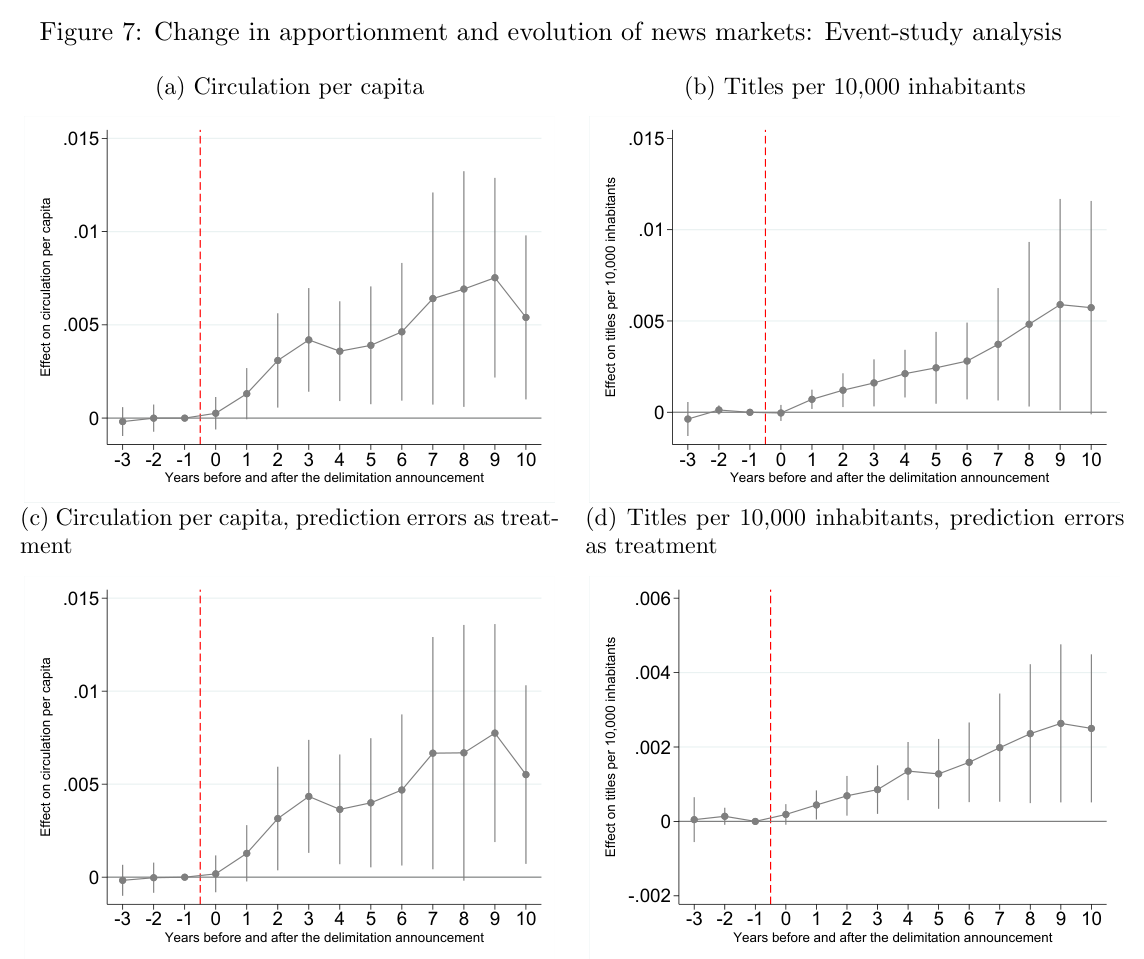
Information conveyed through news media influences political behavior. But to what extent are media markets themselves shaped by political determinants? We build a novel panel dataset of newspaper markets in India from 2002 to 2017 to measure the impact of changes in apportionment on the development of the news industry over time. We exploit the announcement of an exogenous change in the boundaries of electoral constituencies (the 2008 delimitation) to causally identify the relationship between the (future) apportionment of news markets and the change in the number and circulation of newspapers. Using an event-study model and a staggered Difference-in-Differences approach, we show that markets that faced an increase in representation experienced a significant rise in both circulation and the number of titles per capita. News and current affairs newspapers respond more to this increase. Furthermore, we document various dimensions of heterogeneity and show in particular that the magnitude of the estimated effects is larger in places with a relatively low level of newspaper and political competition prior to the 2008 delimitation.
Main graph
-
Poverty-Adjusted Life Expectancy: a consistent index in the quantity and the quality of life
R&R, Review of Economics and Statistics
Abstract
Poverty and mortality are the two major sources of well-being losses. We propose new summary indicators of well-being that account for mortality while being (i) conceptually sound, (ii) easily interpretable and implementable and (iii) sensitive to the distribution of well-being. Our main indicator is the poverty-adjusted life expectancy index. Following the expected life-cycle utility approach à la Harsanyi, it is based on a single normative parameter that transparently captures the trade-off between poverty and mortality. Empirically, we compare countries over time and focus on these situations in which mortality is in conflict with poverty. Once we assume that being poor is (at least weakly) preferable to being dead, we find that about a third of these conflicting comparisons can be unambiguously ranked by the poverty-adjusted life expectancy index. Finally, this indicator naturally defines a new and simple index of multidimensional poverty, the expected deprivation index, which also accounts for unequal lifespans.
-
Stopping rule as sex-selective abortions and instrumental births. A unified framework and world evidence
Submitted
Non-technical summary in French in the Revue d'économie du développement.
Abstract
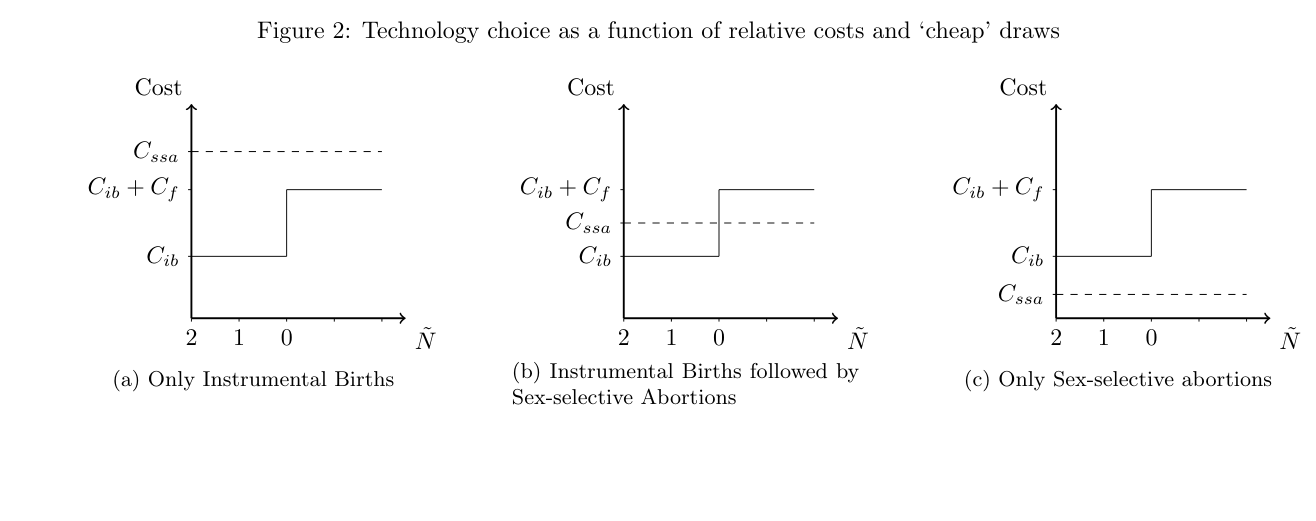
The stopping rule refers to a behaviour by which parents continue child bearing till they reach a specific number of children of a given gender. Under this behaviour, parents can choose to carry out these pregnancies to term and raise a larger number of children than originally desired, or resort to sex-selective abortion by terminating pregnancies of the undesired gender. We argue that these two practices are the two complementary expressions of the stopping rule and ought to be considered under a unified framework. We take the child as the unit of interest and propose new measures of detection of these two practices. With instrumental births, a girl is, on average, exposed to a larger number of younger siblings. Under sex-selective abortion, a boy has on average more sisters among her elder siblings. These measures are easily implementable, precise, and do not rely on a natural sex ratio. We carry out our detection tests over a large set of countries and quantify, for the countries identified by our tests, the magnitude of the gender bias in parental preferences. We highlight, in particular, the minor role played by sex-selective abortion as compared to instrumental births in fertility behaviour.
Main graph
-
The stopping rule may decrease fertility: evidence from a counterfactual analysis
Abstract
Gender-biased fertility preferences are prevalent in many societies. They are commonly thought to be a driver of fertility. We show here that this is not necessarily true: switching from gender-biased to gender-neutral fertility preferences can increase fertility. The magnitude and the sign of the variation in fertility depends on the choice of gender-neutral fertility counterfactual. We illustrate our findings using data from the Indian Demographic and Health Surveys and show that gender-biased fertility preferences can lead to a change ranging from -15% to 23% of total excess fertility, or -4% to 6% of total fertility.
Work in progress
- Democratization, Media Supply and Media Bias: Evidence from the USA
- Majoritarian Systems and Inequalities in Government Interventions: Evidence from India
- The social image cost of motherhood. Evidence from the movie industry
Economics of Identity
-
Affirmative Action, Education and Gender: Evidence from India
Journal of Development Economics (2019)
Online appendix · Raw data and replication files
Press: The Hindu, G-MonD, Ideas for India, LiveMint
Abstract
This paper studies the impact of India’s affirmative action policies for Scheduled Castes on educational attainment. Using a plausibly exogenous variation, I show that affirmative action increases educational attainment. The main improvements are in literacy and secondary schooling and there is only small evidence of increases in higher education. The benefits are not distributed evenly across genders: only males show an increase in education (in literacy, primary and secondary completion). Individuals at the intersection of discriminated groups (low caste and female) may not be benefiting from these policies.
-
Identity Based Policies and Identity Manipulation: Evidence from Colonial Punjab
American Economic Journal: Economic Policy (2015)
Online appendix · Raw data and replication files
Abstract
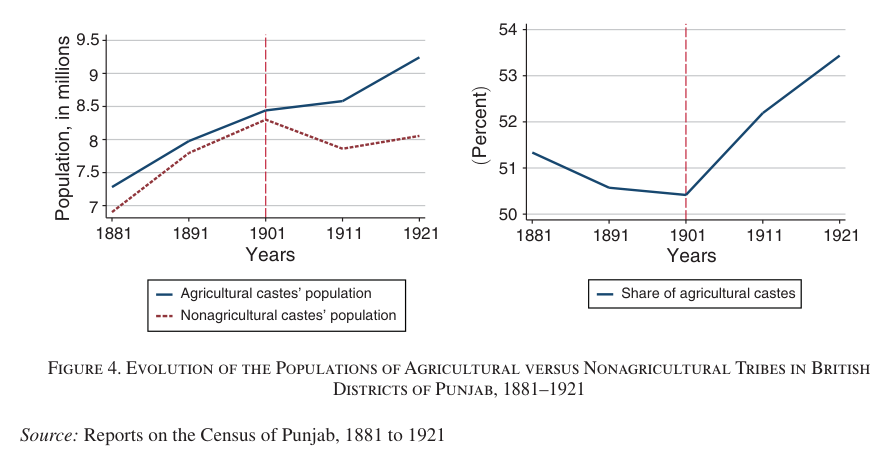
I study identity-marker based policies and demonstrate the existence of identity manipulation. I analyze the impact of the Punjab Alienation of Land Act (1901), a caste-based legislation, on identity manipulation. Using data from the colonial census, I show that a movement of identity manipulation took place in response to the law. I estimate that in 20 years, 7.5 percent of the population that had an incentive to do so manipulated its identity. I then use an accounting exercise to estimate that the amount of mistargeting caused by this manipulation is between 3.9 percent and 8.2 percent of the land distributed.
Main graph
-
Identities and Public Policies: Unexpected Effects of Political Reservations for Women in India
World Development (2021)
Press: Vox.eu, Ideas for India
Abstract
Identity is an important determinant of economic behavior. While the existing literature focuses on one identity dimension at a time, we show that the multiplicity of identity dimensions matters for economic behavior and that neglecting it may lead policymakers to overlook important, unexpected effects of economic policies. We exploit the randomized nature of political reservations for women in India to show that a policy designed along one identity dimension (gender) alters the distribution of the benefits of this policy along another one (caste). We propose differences in gender norms across caste groups as a mechanism.
-
Religion, Politician Identity and Development Outcomes: Evidence from India
Journal of Economic Behavior and Organization (2014)
Press: Business Standard
Abstract
This paper investigates whether the religious identity of state legislators in India influences development outcomes, both for citizens of their religious group and for the population as a whole. Using an instrumental variables approach derived from a regression discontinuity, we find that increasing the political representation of Muslims improves health and education outcomes in the district from which the legislator is elected. We find no evidence of religious favoritism: Muslim children do not benefit more from Muslim political representation than children from other religious groups.
Demographic Economics
-
“Too young to die”. Deprivation measures combining poverty and premature mortality
American Economic Journal: Applied Economics (2021)
Online appendix · Press: VoxDev
Abstract
Most measures of deprivation concentrate on deprivation among the living population and, thus, ignore premature mortality. This omission leads to a severe bias in the evaluation of deprivation. We propose two different measures that combine information on poverty and premature mortality of a population. These measures are consistent and satisfy a number of desirable properties unmet by all other measures combining early mortality and poverty. Moreover, one measure is readily computable with available data and easily interpretable. We show that omitting premature mortality leads to an underestimation of total deprivation in 2015 of at least 36% at the world level.
Political Economy and Economic History
-
Enfranchisement, Political Participation and Political Competition: Evidence from Colonial India
Journal of Economic History (2025)
Press: Vox Talks
Abstract
We examine how political participation and political competition are shaped by two class-based extensions of the franchise in 20th-century India by creating a new dataset of district level political outcomes between 1921 and 1957. We find that both the partial franchise extension of 1935 and the universal suffrage reform of 1950 led to limited increases in citizen participation as voters or candidates, and neither reform had a significant effect on measures of political competition. Despite the limited effects on political outcomes, districts with greater enfranchisement increases also experienced higher education provision by provincial governments.
-
Income concentration in British India, 1885–1946
Journal of Development Economics (2017)
Online appendix
Abstract
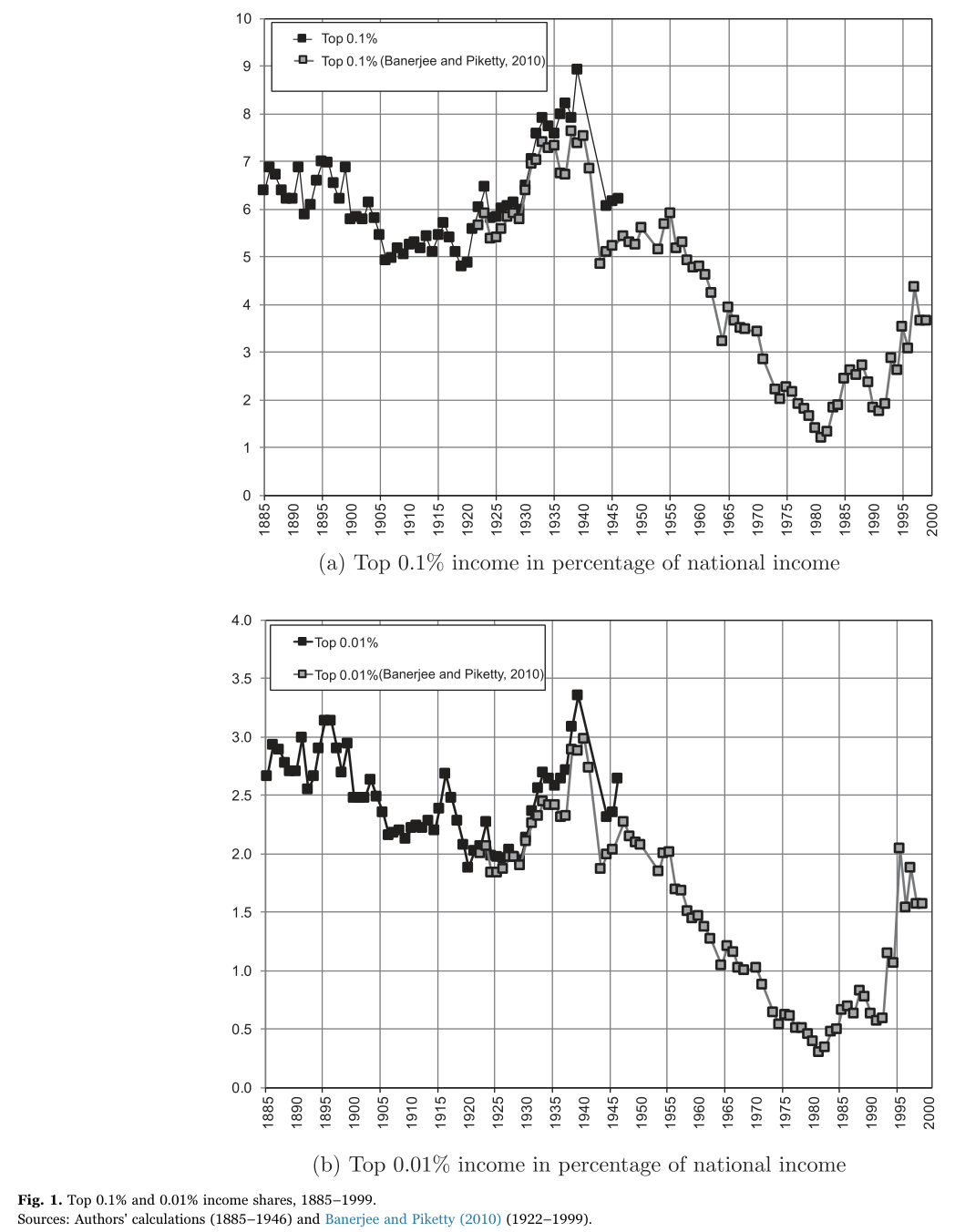
We use a novel income tax data set to present evidence on the evolution of income concentration in the last 60 years of colonial rule in India. These data allow us to study the evolution of income concentration at the country level as well as the location of top income earners across provinces. We identify three key facts: (1) the evolution of income concentration in British India was nonlinear, following a U-shape, (2) the majority of top income earners were non-Europeans, and (3) the geographical location of top income earners changed over time with the province of Bombay gaining in importance in the early XXth century. We provide an interpretation of these results in the light of the economic and political changes in British India over the period.
Main graph
COVID-19
-
The impact of 2020 French municipal elections on the spread of COVID-19
Journal of Population Economics (2022)
Replication files · Media briefing (in French) · Press coverage
Abstract
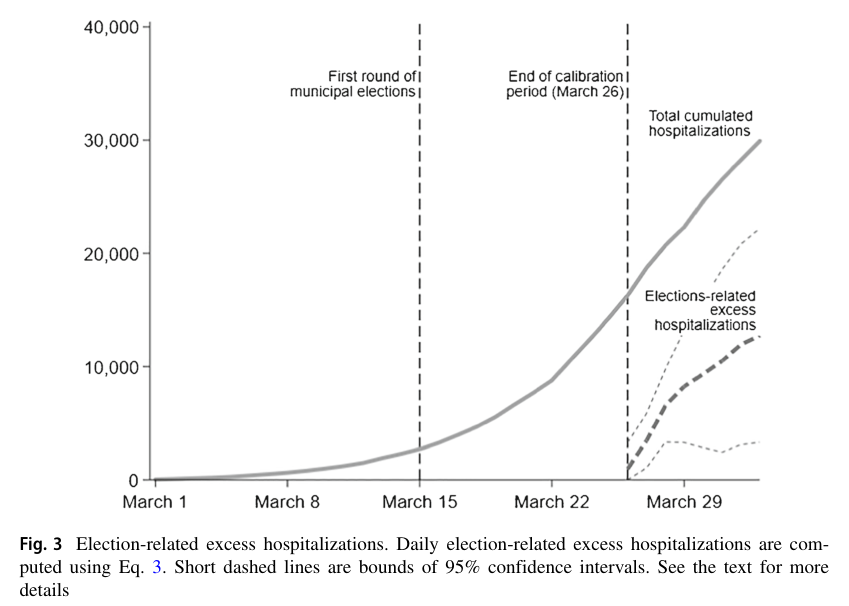
Soon after the onset of the COVID-19 pandemic, the French government decided to still hold the first round of the 2020 municipal elections as scheduled on March 15. What was the impact of these elections on the spread of COVID-19 in France? Answering this question leads to intricate econometric issues as omitted variables may drive both epidemiological dynamics and electoral turnout, and as a national lockdown was imposed at almost the same time as the elections. In order to disentangle the effect of the elections from that of confounding factors, we first predict each department’s epidemiological dynamics using information up to the election. We then take advantage of differences in electoral turnout across departments to identify the impact of the election on prediction errors in hospitalizations. We report a detrimental effect of the first round of the election on hospitalizations in locations that were already at relatively advanced stages of the epidemic. Estimates suggest that the elections accounted for at least 3,000 hospitalizations, or 11% of all hospitalizations by the end of March. Given the sizable health cost of holding elections during an epidemic, promoting ways of voting that reduce exposure to COVID-19 is key until the pandemic shows signs of abating.
Main graph
-
Political regime and COVID-19 death rate: efficient, biasing or simply different autocracies? An econometric analysis
SSM – Population Health (2021)
Replication files
Abstract
The difference in COVID 19 death rates across political regimes has caught a lot of attention. The “efficient autocracy” view suggests that autocracies may be more efficient at putting in place policies that contain COVID 19 spread. On the other hand, the “biasing autocracy” view underlines that autocracies may be under reporting their COVID 19 data. We use fixed effect panel regression methods to discriminate between the two sides of the debate. Our results present a more nuanced picture: once pre-determined characteristics of countries are accounted for, COVID 19 death rates equalize across political regimes during the first months of the pandemic, but remain largely different a year into the pandemic. This emphasizes that early differences across political regimes were mainly due to omitted variable bias, whereas later differences are likely due to data manipulation by autocracies. A year into the pandemic, we estimate that this data manipulation may have hidden approximately 400,000 deaths worldwide.
Non-academic publications
- Avortements sélectifs, naissances instrumentales et la règle d'arrêt Revue d'Économie du Développement, forthcoming Non-technical summary in French of Sex-Selective Abortions and Instrumental Births as the two faces of the Stopping Rule.
- The Economics of Caste Chapter prepared for the Oxford Handbook of Caste in Contemporary/Modern Times, Surinder S. Jodhka and Jules Naudet eds.
- La caste dans l'Inde en développement Collection du CEPREMAP, Éditions Rue d'Ulm (2015). In French.
- Économie des politiques publiques Repères, La Découverte (2010). Co-authored. In French. A few pages here.
- Migration “Push” Factors in Non-OECD Countries over the Long Run In The Future of International Migration to OECD Countries, OECD (2009).